
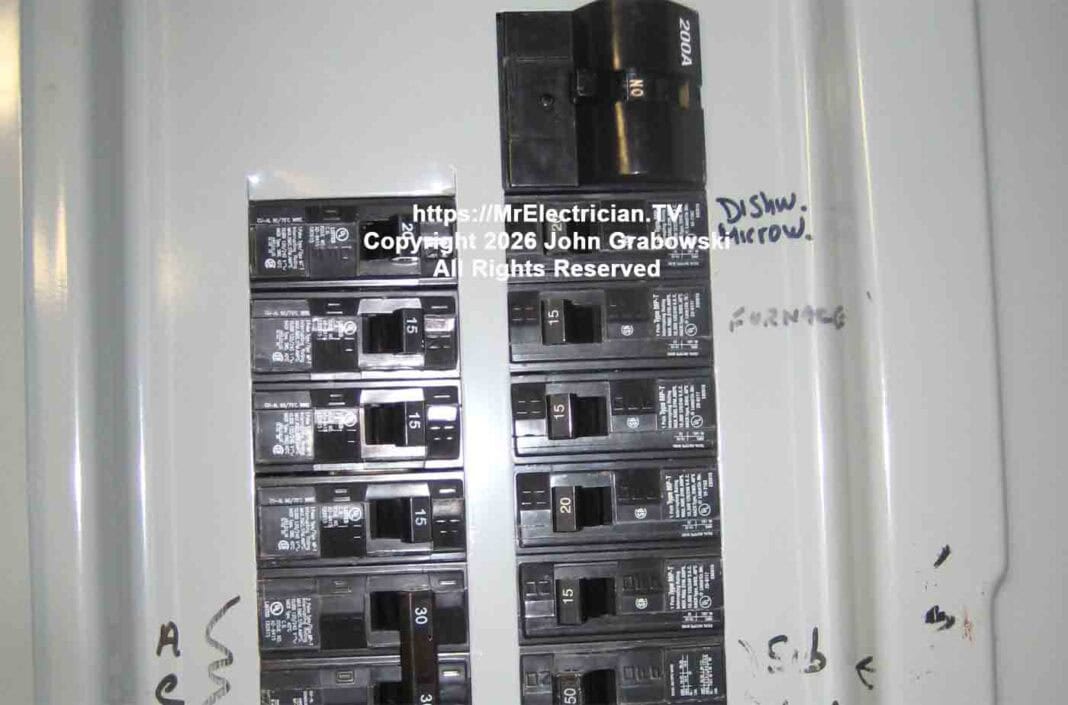
Dear Mr. Electrician: Why does my circuit breaker keep tripping?
NOTE: Some text links below go to applicable products on Amazon. As an Amazon Associate, I earn from qualifying purchases. Using my links helps to keep this website FREE.
Answer: A circuit breaker trips to protect your home from electrical danger. The most common causes are an overloaded circuit, a short circuit, an arc fault, or a ground fault. Identifying which one is happening is the key to fixing the problem safely.
Additionally, a defective or old circuit breaker can be the cause.
Table of Contents:
- What does a Circuit Breaker Do?
- Ground Fault Circuit Interrupters
- Arc Fault Circuit Interrupters
- Dual Function Circuit Breakers
- Finding the Problem
WHAT DOES A CIRCUIT BREAKER DO?
A circuit breaker is a safety device inside your electrical panel. Its job is to prevent wires from overheating, shut off power automatically when there’s a problem, and reduce the risk of electrical fires. When a circuit breaker trips off, it’s doing exactly what it was designed to do, protect your home and your electrical wiring.
A wire will overheat when it has more electrical current (Amps) flowing through it then it was designed for. A wire rated for 15 amps is protected by a circuit breaker rated for 15 amps. When more than 15 amps is flowing due to more appliances or equipment being used on one circuit, the circuit breaker will trip off. An example of this would be if a portable space heater is running, and you plug a heavy duty vacuum cleaner into the same 15 amp electrical receptacle outlet.
Usually the circuit breaker will not trip off immediately when the circuit is slightly overloaded. It may take several minutes, particularly if whatever is plugged in normally cycles on and off. The larger the overload, the faster the circuit breaker will keep tripping off.
Some common household appliances that are reasons why your circuit keeps tripping off are electric space heaters, air conditioners, microwave ovens, and hair dryers.
Another reason why your circuit breaker keeps tripping off is due to a short circuit. This is when a live LINE wire comes in direct contact with a NEUTRAL wire, a GROUND wire, or a grounded surface. When a short circuit occurs, an unlimited amount of amps can flow through the wires. The circuit breaker will trip immediately. You can sometimes hear a buzzing sound or a pop from the circuit breaker tripping off when this happens. When you try to reset the circuit breaker it immediately trips off again.
Some things that can cause a short circuit are driving a nail or screw into a wall and you inadvertently penetrate an electrical wire, or a household pet chewing on a long appliance cord. I have even seen metal electrical outlet wall plates become loose and fall onto the two prongs of a plug in the outlet causing the circuit breaker to trip off.
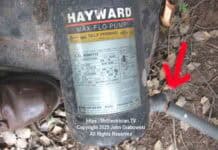
I had a client with a sump pump in a pit filled with water. The pump worked, but the circuit breaker would trip frequently whether or not the pump was on. It turned out that the pump was old and rusty and water was getting into the electrical wiring compartment. This created a high resistance short circuit. The wires were shorting together through the water, but due to the water not being a great conductor of electricity the current flow was limited and the circuit breaker tripped only after a while.
I have also found that a loose connection on the circuit breaker can cause it to trip due to the heat build-up from arcing. The loose connection can be the wire under the screw terminal or on the back where the circuit seats onto the electrical panel bus bar.
GROUND FAULT CIRCUIT INTERRUPTERS
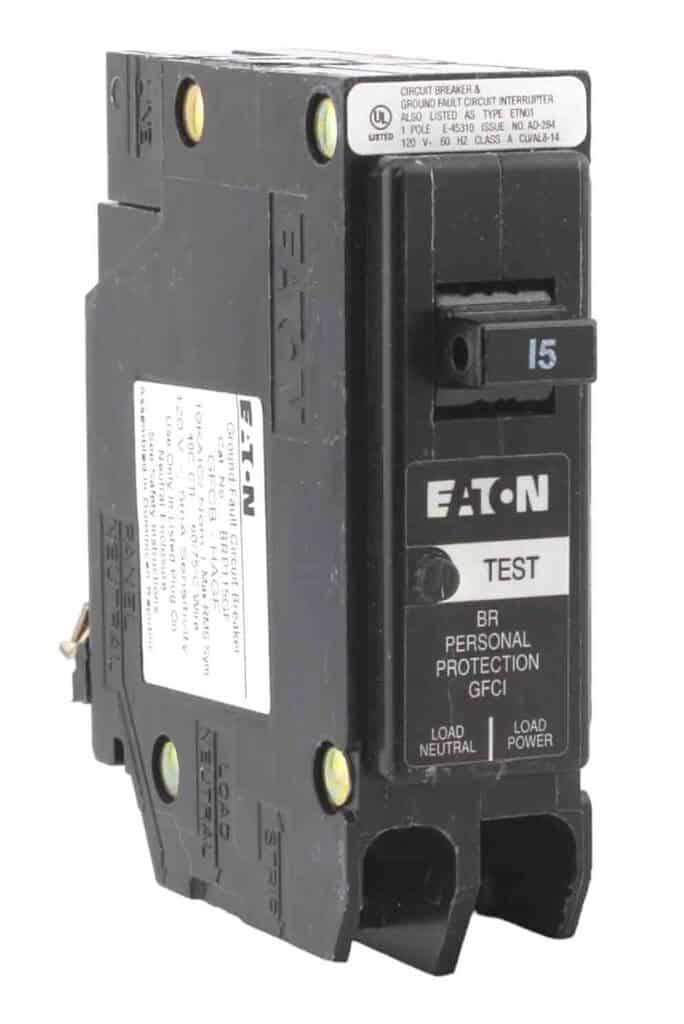
Another type of circuit breaker is the Ground Fault Circuit Interrupter (GFCI). It provides an additional level of protection for humans as well as for the electrical wiring. A GFCI works the same as a standard circuit breaker protecting the wires, but it also has a much lower threshold for tripping the circuit breaker off under certain circumstances.
A GFCI circuit breaker will trip off if a current over 5 milliamps flows through a human being. If you were standing barefoot on a wet lawn and accidentally came in contact with a live wire, the GFCI circuit breaker would trip off immediately to prevent an electrical shock or electrocution. A GFCI circuit breaker will also trip off if the NEUTRAL and GROUND wires come in contact with each other
GFCI’s are commonly used for electrical receptacle outlet circuits in kitchens, bathrooms, laundry areas, garages, basements, and outdoors. Sometimes the protection is from a GFCI receptacle outlet instead of a GFCI circuit breaker.
Some appliances and equipment are not rated for use on a GFCI protected electrical circuits. Always check the owners manual online before buying anything powered by electricity.
There are several types of GFCI circuit breakers. The ones that I am referring to here are rated for 5 milliamps for the protection of human life. There are other GFCI’s with a rating of 30ma or more which are for equipment protection only. Always check the labels.
Read my article here about the effects of electricity on the human body.
A GFCI circuit breaker has a test button, like GFCI receptacle outlets, to make sure that it is working properly.
ARC FAULT CIRCUIT INTERRUPTERS
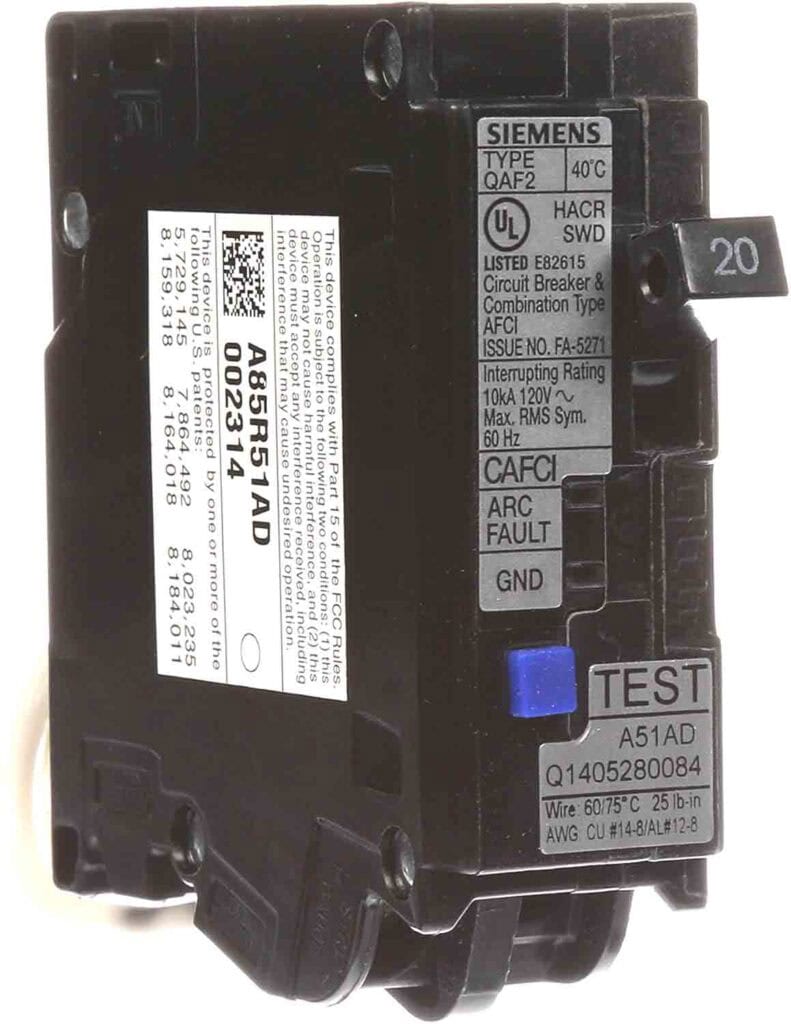
Arc Fault Circuit Interrupters (AFCI) provide protection against arcing in addition to what a regular circuit breaker does. Arcing occurs when there is a loose connection somewhere in the electrical circuit or whatever is plugged into an electrical outlet. They also are used on lighting circuits and are affected by problems with lighting fixtures and ceiling fans.
Arcing is bad because it generates heat and sparks. If that were to come in contact with something combustible such as a wood stud in the wall or curtains hanging in front of an outlet, a fire could easily start.
Arcing can occur when there is a loose connection on an electrical outlet and a load is on the circuit. It could also happen when an old outlet cannot hold a plug in it tightly and the plug sparks when whatever is plugged in is turned on. A worn out light switch can spark more than it normally does causing the AFCI circuit breaker to trip off.
I think, out of all the types of circuit breakers, AFCI’s are probably the most difficult to diagnose. There is a built-in diagnostic code for AFCI’s that can give you some insight for troubleshooting. The codes are different for each circuit breaker manufacturer and you would need the trip indicator guide for your brand of circuit breaker. Most electrician’s will leave behind the trip indicator guide after they have installed an AFCI circuit breaker.
I have found that some electrical equipment and appliances do not get along well with AFCI’s. Some manufacturers do not recommend having their equipment on AFCI electrical circuits. I had one client who had an electric treadmill that would trip the AFCI circuit breaker every time it was shut off.
Another client had a finished basement that was wired by his unskilled son. There were many problems everywhere. One that stands out was one section of electrical cable that was causing the AFCI circuit breaker to constantly trip. There wasn’t anything visibly wrong with the cable, but after I replaced that section the AFCI circuit breaker stopped tripping. Sometimes a cable staple hammered too far in can cause an AFCI to trip.
Older AFCI circuit breakers have had a problem with Radio Frequency Energy from transmitters. This issue has mostly been eliminated in new models.
Just like GFCI’s, an AFCI circuit breaker will also trip off if the NEUTRAL and GROUND wires come in contact with each other.
For more information about Arc Fault Circuit Interrupters and the diagnostic codes, read my article here.
DUAL FUNCTION CIRCUIT BREAKERS
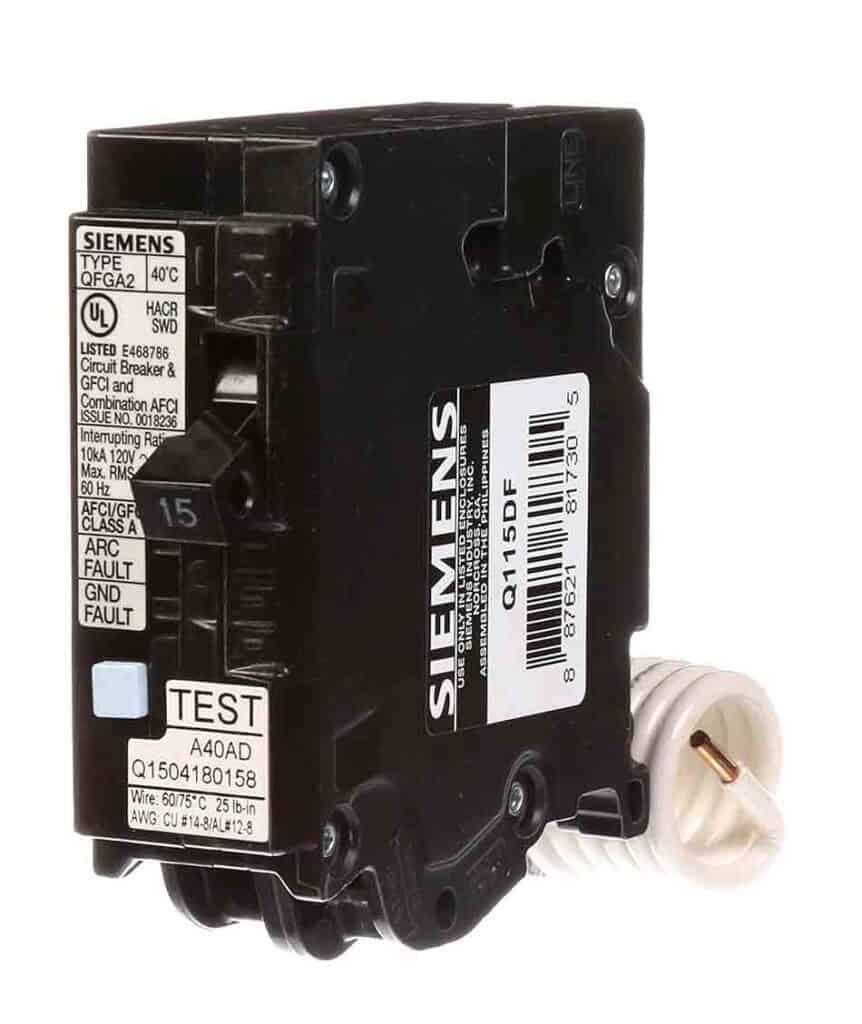
Dual Function Circuit Breakers have AFCI and GFCI protection combined. It is important to have the trip indicator guide for these circuit breakers so that you can see if the circuit breaker tripped off due to an arc fault, a ground fault, or an overload condition.
Here is the diagnostic guide for Siemens GFCI and AFCI circuit breakers.
Here is the diagnostic guide for Square D GFCI and AFCI circuit breakers.
Here is the diagnostic guide for Eaton Cutler-Hammer type BR and type CH AFCI and GFCI circuit breakers.
Here is the diagnostic guide for ABB GE, AFCI and GFCI circuit breakers.
Here is the diagnostic and installation guide for Leviton AFCI circuit breakers.
FINDING THE PROBLEM
First thing is to observe the behavior of your tripping circuit breaker. Does it trip as soon as it is reset? Does it even allow it to be reset? Is there a short delay before the circuit breaker trips? Does the circuit breaker tripping occur at odd hours or with no pattern? Does the tripping only occur at night?
To reset a circuit breaker, push the handle to the OFF position then push it to ON.
If your circuit breaker trips immediately or doesn’t reset at all it could be due to a short circuit. Not being able to reset could also indicate a bad circuit breaker. If there is a short delay before the breaker trips it could be due to a small overload condition. If the circuit breaker trips with no apparent reason at odd hours, it could indicate that there is a small momentary overload or a bad circuit breaker that cannot handle the full rated load.
As an electrician I would start with the simple things such as unplugging everything on the problem circuit. If nothing changed by unplugging, I would open up the electrical panel and try switching the wire from the tripping circuit breaker to another circuit breaker to see if the circuit breaker is the problem. After ruling out a defective circuit breaker, I would try putting an ammeter on the circuit wire and see what the actual load is that’s causing the circuit breaker to trip off.
If the ammeter spiked to the top it could indicate a short circuit. If the ammeter showed several amps over the circuit breaker rated load, I would consider if it was a defective piece of equipment or a short circuit that had much resistance such as a motor with a bad winding.
To narrow things down in order to find what is causing your circuit breaker to trip, I would open up outlets, switches, and junction boxes on the problem circuit and disconnect the wires that feed other outlets and switches. If the circuit breaker resets, that would indicate that the problem is further down the line. In the example I gave above about the sump pump, the original complaint was about the bedroom outlets not working. The homeowners did not know the basement sump pump was on the same circuit.
See my article explaining electrical terminology here.
I have a few methods for tracing circuits. You can see them here.
To help keep this website FREE, please use this Amazon link for all of your purchases.
Click for a FREE copy of my book “Almost Everything You Need To Know To Repair a Bathroom Exhaust Fan In Your Home.”
Get your required “Emergency Disconnect, Service Disconnect” labels and stickers to satisfy the 2023 National Electrical Code requirements in article 230.85(E)(1) and (2) by going to my Zazzle Shop here.
Visit my Link Tree for social, stickers, and merchandise links.